No products in the cart.
08 October 2026

Staff working in high-risk environments, particularly those who may encounter aggressive, volatile or unpredictable situations, need to know that help is always within reach. Across Ireland, more organisations are investing in staff safety alarms to ensure employees can call for assistance quickly and discreetly when incidents escalate.
However, installing an alarm system is only part of the solution. The real question is whether it can be relied upon every time it is needed.
In this blog, we look into the limitations of WiFi-dependent staff attack alarms and why WiFi dependence is an increasingly important consideration for organisations across Ireland.
In many healthcare settings, alarm systems operate over internal WiFi networks provided by organisations such as the HSE. While these networks support day-to-day communication and IT systems, they are not always designed to act as the backbone of a critical safety system. Even where WiFi is available, reliability can fluctuate.
Large or complex buildings often contain connectivity blind spots, and network performance can be affected by structural features, competing demand or routine outages. For general staff communication, this may be manageable, but for a staff safety alarm system, it presents a more serious concern.
When an alarm relies on WiFi to transmit a call for assistance, the network becomes a critical link in the response chain. If connectivity weakens or drops at the moment the alarm is activated, the signal may be delayed, disrupted or fail entirely. In higher-risk environments, that failure can leave staff and service-users exposed in situations where immediate support is essential.
There is also another important consideration, location accuracy. Many WiFi- and radio-based alarm systems estimate the caller’s position using signal triangulation. In practice, this can result in approximate location data rather than the exact room or point of activation. In fast-moving or high-risk situations, imprecise information can slow response times and increase confusion.
Unreliable transmission or inaccurate location data can erode confidence over time. If staff begin to doubt whether an alarm will work consistently or whether their precise location will be identified, usage may decline and response procedures can lose effectiveness, undermining the purpose of the system.
The Pinpoint P2 System was developed to remove the uncertainty that comes with network reliance.
Rather than depending on WiFi triangulation or mobile connectivity, Pinpoint’s staff safety alarms operate using infrared technology. This allows emergency calls to be triggered and received without relying on the internet, creating a more stable and resilient solution for staff protection.
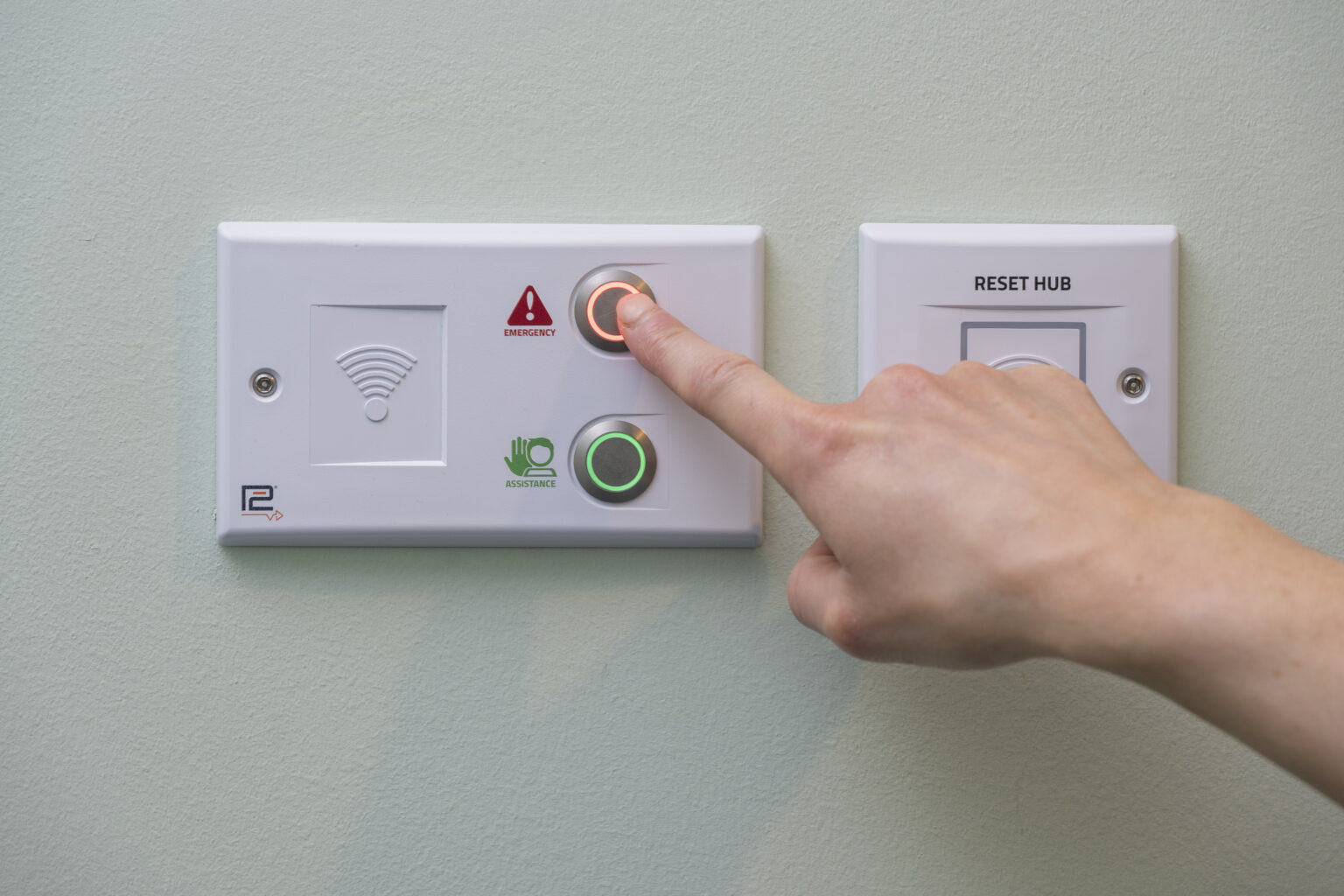
At the centre of the system are our P2 Personal Infrared Transmitters (PITs) – wearable panic alarms designed for staff working in higher-risk environments. When activated, the device emits coded pulses of infrared light to receivers installed discreetly throughout the building, usually in the ceiling. These receivers immediately relay the alert to response teams, displaying the exact location of the caller and the call level across stationary display units, pagers and other communication devices. The entire process takes just 85 milliseconds.
Because the system does not rely on WiFi triangulation or radio signal strength, it delivers precise, room-level accuracy every time. Response teams know exactly where assistance is required, reducing delays and uncertainty.
While Pinpoint Systems do not require WiFi to function, organisations can enhance response capabilities through optional tools such as Mobile Alert and PC Alert.
The Mobile Alert App allows notifications to be forwarded to subscribed devices, ensuring key personnel remain informed even when away from a central control point. PC Alert provides real-time updates directly to desktop computers, creating an additional monitoring point in busy operational areas.
Importantly, these features enhance the system without replacing its core reliability.
The advantages of WiFi-independent staff safety alarms are most apparent in complex healthcare environments where internal connectivity cannot be guaranteed across every corridor and room.
At Markievicz House, a healthcare setting that includes an older building with thick walls and a complex internal layout, consistent internal WiFi coverage cannot always be assumed. The centre houses a Primary Care Psychology Service, providing first-line support for children, young people and adults experiencing mild-to-moderate mental health presentations. In such environments, situations may arise where staff require additional support quickly and discreetly.
For this location, one of the key factors influencing the HSE’s decision to implement the Pinpoint System was its independence from internal WiFi infrastructure and its ability to provide exact location information every time an alarm is activated.
WiFi-based solutions may suit some environments, but where connectivity cannot be guaranteed, relying on wireless networks introduces avoidable risk. Infrared-based systems provide a more dependable alternative, delivering accurate, always-on protection without WiFi dependence.
For organisations across Ireland seeking staff safety alarms that work reliably in every setting, Pinpoint offers a proven solution designed to support staff whenever and wherever they need it. Contact us today to learn more.